

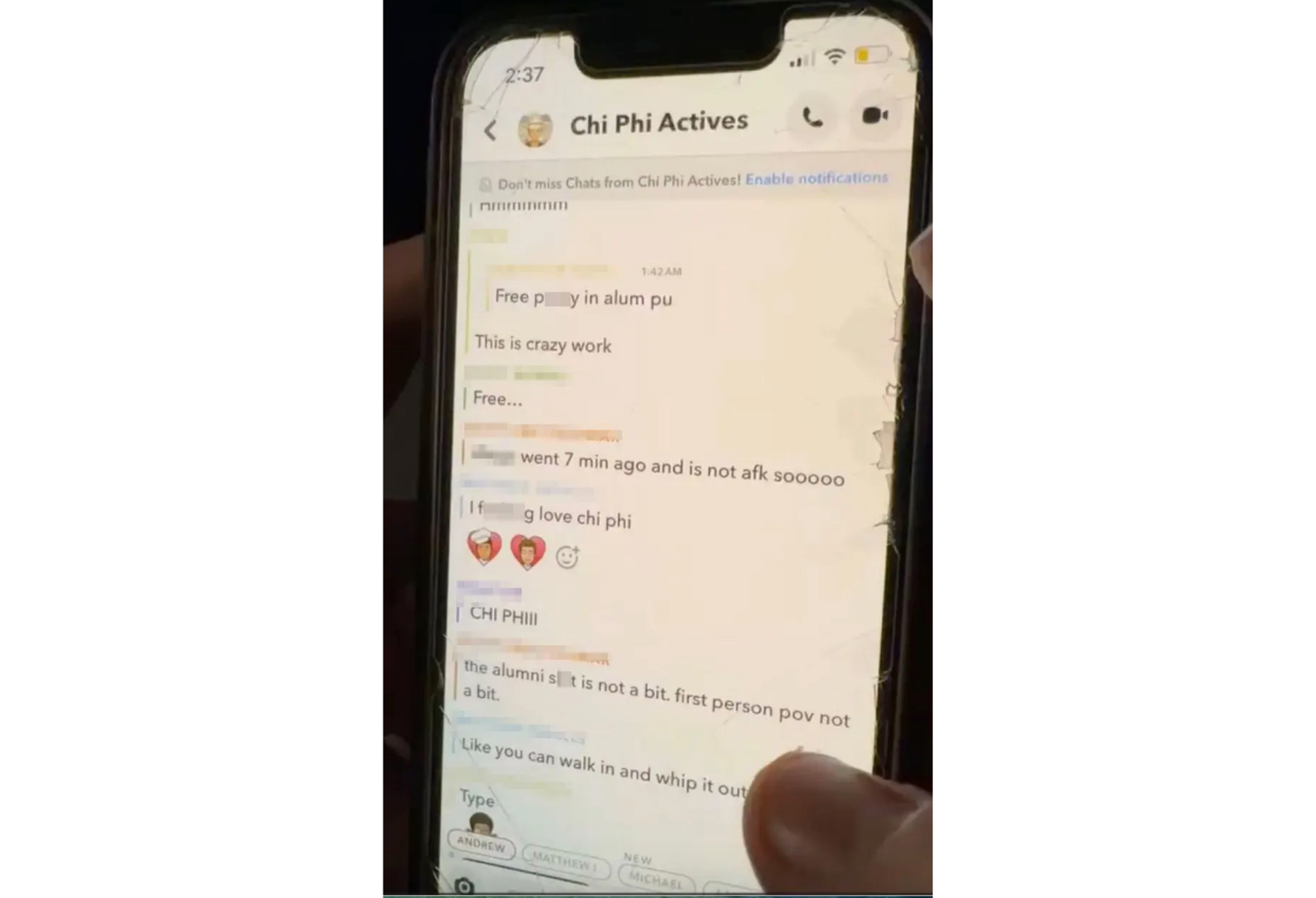
Seven harrowing hours. For the length of an average shift at a coffee shop, a twenty-year-old woman, identified as Jane Doe in court documents, endured a violent sexual assault by seven men, all fellow students at the Cornell University, an Ivy League university in New York State, USA. During a party hosted by a fraternity—an exclusive social group of male students—a Snapchat message sent to its members claimed there was “free pussy” upstairs. "Shop still open?" a member wrote later. “Yea,” came the reply.
Chi Phi had 57 active members. We do not know how many saw the messages, but anyone who read them and did not intervene was complicit. The pattern is familiar: sexual violence is rarely sustained without the networks that enable it or look away.
What Jane Doe Says Happened
Jane Doe’s account in her now sealed civil complaint is deeply disturbing. When she reached the Chi Phi fraternity house around 11 pm on October 19, 2024, she had already been drinking for several hours and was visibly intoxicated when three or four fraternity members let her in. She had come to see her friend Matthew Ingalls, who greeted her with another beer. They danced. Then, away from the main room, he propositioned her for a threesome with another fraternity member. Her complaint states that Jane Doe was incapable of consenting in her drunken state. Ingalls took her upstairs, where she was pressured into snorting ketamine, a drug she had never used before, and was also given marijuana and high-proof rum. The complaint then describes a series of sexual assaults involving several men. At 1:42 am, Newell sent the message to the Snapchat group. More fraternity members entered the room. Jane Doe, naked, retreated beneath the covers to hide herself. The filing says that all seven men later named in the lawsuit snorted ketamine off Doe’s body.
Jane Doe says her phone was unreachable, and she felt as if there was no way for her to escape this room full of “predatory fraternity men”. She was then taken into another room by two of them, who instructed her to take more ketamine. By then, the complaint says, she was completely incapacitated. The final assault ended at around 5:45 am when she lost consciousness.
The complaint names all seven men as participants in the alleged sexual assault and rape: Matthew Ingalls, Johnathan Newell, Winston Lee, Gillio Lopes, Diego Sarabia, Scott Norris, and Scott Kretzschmar. Later that day, Jane Doe learned that what had happened at the Chi Phi house was becoming known on Cornell’s campus. With encouragement from friends, she reported the incident to Cornell University Police on or about November 8, 2024. The same day, according to the complaint, the Chi Phi chapter was placed on temporary suspension for alleged violations of the university’s student code of conduct.

Cornell’s Version of Accountability
Cornell says it conducted a months-long investigation, imposed temporary suspensions, and closed Chi Phi, the fraternity chapter in question. CBS reports two of the seven accused were expelled, two suspended for at least two semesters, one had already graduated before sanctions could be imposed, and two were found not responsible for sexual misconduct.
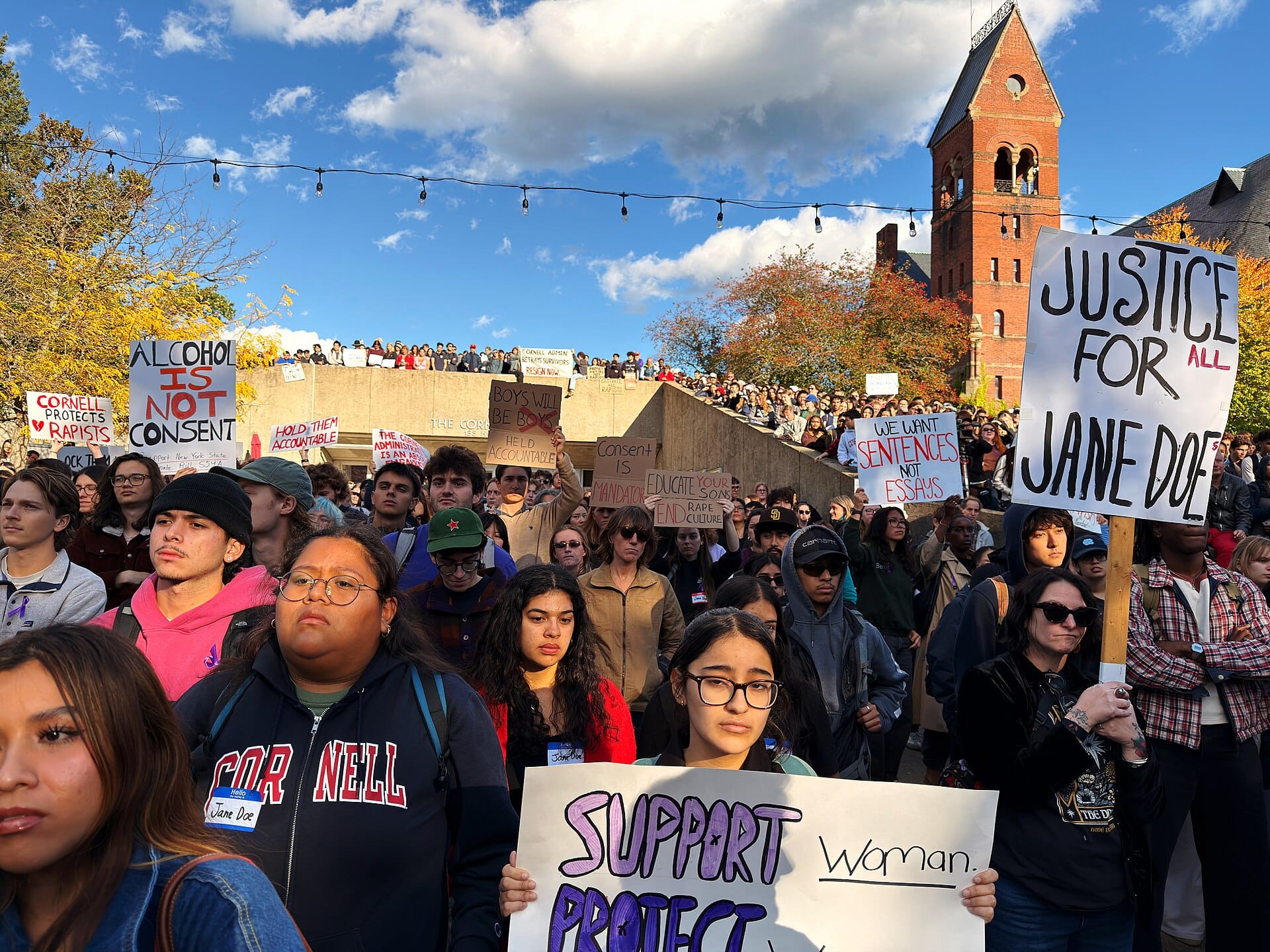
Before eventually dropping out, Jane Doe stayed on for a whole semester seeing these men on a “fairly regular basis,” an ordeal her lawyer describes as “horrifying." Cornell refused her request of a refund of the thousands of dollars she had paid for her tuition. On September 28, amid widespread public outrage following Jane Doe’s civil suit, the local District Attorney reopened the criminal investigation.
What Fraternities Are and How They Propagate Rape Culture
In US universities, “Greek Life” is a fraternity and sorority system, historically divided along a male/female gender binary, in which young students are selected for social clubs. Hazing—coercive initiation practices, including humiliation and forced acts—are common in these groups.
The culture of American fraternities has always been a cause for concern. Research dating back to the mid-2000s had already found frat brothers raped 300% more. Given the entrenched rape culture and institutional complicity, it would be laughable to expect any meaningful reform; many argue for shutting fraternities down altogether. Fraternities have been the subject of multiple high-profile controversies ranging from drug trafficking rings to other sexual assault cases.
Fraternities promote a culture of secrecy and mutual protection—much like the networks of power and privilege among the global elite that shield and advance each other’s misogyny. The average fraternity member at an American university is considerably more economically privileged. Fraternities work under a dues and fees structure that can run into thousands of dollars. Typically, members live in a chartered fraternity house—a group of men of privilege living in proximity, creating bonds of loyalty, and their “bro-code” extends well beyond campus life.
Sexual misconduct becomes more salient when it happens at high-profile institutions because these institutions are producing future politicians, decision makers, business moguls, and, statistically, top one-per cent earners. They form a direct pipeline feeding rape culture into our social spheres, while producing the people who go on to steward the laws and policies that uphold it.
An archived page from the Cornell University website claimed 80 per cent of Fortune 500 executives, 76 per cent of U.S. senators and congressmen, 85 per cent of Supreme Court justices, and all but two presidents since 1825 have been fraternity men.
The New Brazenness of Rape Culture
Getting away with sexual assault is not new. What has become newly brazen is the public spectacle of rape culture and networks of elite power that continue to shield the impunity of perpetrators. It can’t be lost on us that Jane Doe’s story, along with many others that have made headlines, comes at a time when the President of the United States has himself been accused of sexual misconduct and rape, including of minors. When Donald Trump ran in the 2016 Presidential election, a now-infamous 2005 audio was released in which he can be heard gloating about grabbing women “by the pussy.” Despite outrage, nationwide protests, and the obvious misogyny of his comments, he was elected into office just over a month later. His comments were waved off as inconsequential “locker room talk”, and a “boys will be boys” problem.
In the decade since, at least 28 women have publicly accused Trump of sexual assault or sexual misconduct, with allegations spanning several decades. In the days after his re-election, the Institute for Strategic Dialogue reported a spike in online misogyny across platforms like X, forums, blogs, Reddit, and YouTube. Within 24 hours, there was a 4,600% increase in mentions of the terms “your body, my choice” and “get back in the kitchen” on Elon Musk’s X.
Let’s not forget how Musk has turned misogyny into a light sport: from Grok’s non-consensual nudity to his pronatalist fixation and reduction of women to reproductive bodies. When pop megastar Taylor Swift endorsed Kamala Harris for the 2024 presidential campaign, Musk mocked her by saying, "Fine Taylor... you win... I will give you a child and guard your cats with my life." Musk, like Trump, is also an alumnus of the University of Pennsylvania, an Ivy League institution. Another former fraternity alumnus is Meta CEO Mark Zuckerberg. In 2003, he created Facemash, the misogynistic precursor to Facebook, which used Harvard students’ photos without their consent and invited users to vote on who was “hotter.” Meta platforms now reach billions of users.
X and Meta platforms also serve as powerful vehicles for the surging “manosphere”, which is the same vitriolic brand of rape culture that claims entitlement to women's bodies, and fuels homophobia and transphobia. You could think of Trump as the manosphere’s mascot and Musk and Zuckerberg, their megaphones.
Epstein and Elite Universities
The troubling relationships universities maintain with powerful predatory men extend well beyond their alumni networks. Consider Jeffrey Epstein, the financier and sexual predator who died in prison in 2019. He sexually assaulted and trafficked girls and women for decades while cultivating relationships with powerful men in politics, business, and academia. Though not an Ivy League alumnus, he used his university connections to “lure and silence” his victims by promising them admission and paid tuition to schools like Columbia.

Massachusetts Institute of Technology (MIT) concealed aspects of its relationship with Epstein: after his 2008 conviction, it accepted nine donations from him, six for its Media Lab. He visited MIT nine times between 2013 and 2017. Meanwhile, Columbia University admitted that an irregular admission to its dental school leadership coincided with talks about fundraising with Epstein.
Epstein’s eventual arrest came only after years of institutional “accommodation.”
The Rot in Elite US Universities
Nefarious ties to Epstein, mistreatment of Palestine supporters, toxic fraternity culture, and failure to protect sexual assault survivors expose the rot beneath elite US universities. It’s time to strip these institutions of their power and privilege. Placing Ivy League universities on these pedestals of prestige is a form of complicity in sustaining the deplorable elitist hierarchies these institutions produce.
Universities like Harvard and Brown have historically benefited from, the transatlantic slave trade. Yale and Princeton have financial ties to fossil fuels. Legacy and donor admissions undermine claims of meritocracy. A landmark 2023 study found that children from families in the top 1% are twice as likely to attend an Ivy-Plus college (Ivy League Universities plus Stanford, MIT, Duke, and the University of Chicago) as middle-class families with comparable scores.
After weeks of intense public scrutiny for its outrageous handling of the case, Cornell recently made small moves like banning fraternity parties for the remainder of this year. Cornell’s Faculty is considering a vote on a formal declaration saying they have lost trust in the University’s leadership over its handling of sexual assault allegations. Professor Paul Ortiz said the university tends to treat rape as a “PR problem.”
What Cornell Could Have Done
Cornell could have done far more to protect Jane Doe. It could have ensured she did not have to keep encountering those on campus. It could have returned her tuition fees, offered reparations, and initiated survivor-led discussions, training, and restorative justice initiatives to confront rape culture. With all its resources, Cornell could have made a serious attempt at institutional accountability. Yet, according to Jane Doe’s complaint, some of the accused were able to reduce their sanctions by simply writing essays. She eventually dropped out. Since her story became public, Jane Doe has faced harassment in the form of doxxing, swatting, and death threats. Her lawyer says she fears for her safety. Where is justice for Jane Doe?
Edited by: Noopur Tiwari